
Qualifications
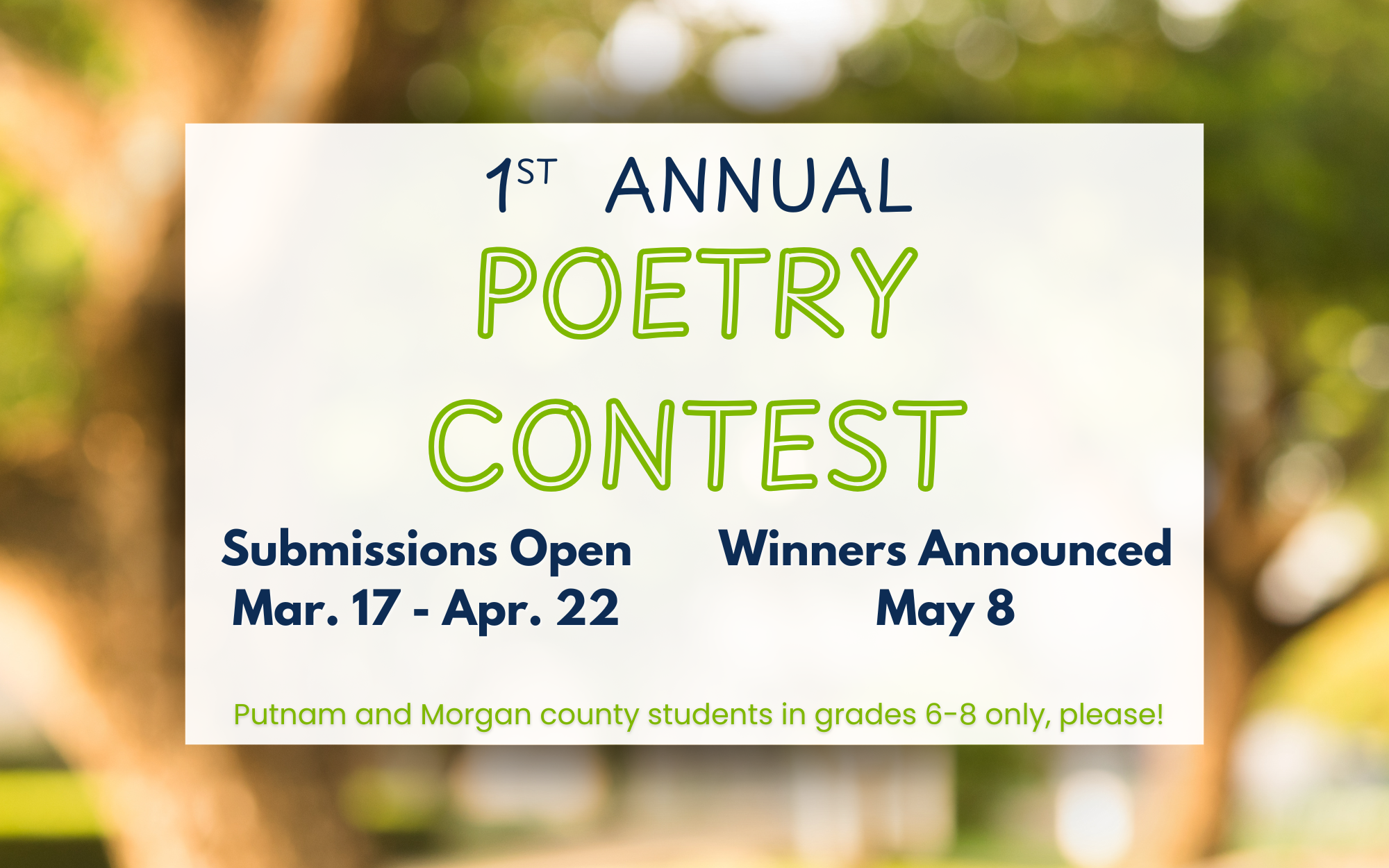
- Must be a Georgia resident in Putnam or Morgan county to participate.
- Must be in grades 6-8 to participate.
(Each grade level will be judged separately.) - Students in public and private schools and homeschool students are welcome to participate.
Rules
-
Poems can be up to 1 page in length.
- The theme for poetry is nature, Earth Day, or the environment.
-
Forms of poetry may include Limerick, Haiku, Rhyming Verse, Free Verse, Elegy, or Sonnet
- Must be an original piece written by the student. Plagiarized entries will be disqualified.
- Only one entry per person will be accepted in this contest.
- Only single author stories qualify (no co-authored stories).
- Must be submitted online in the form below.
Judging
A panel of judges, primarily teachers and/or published writers, is selected by Georgia Writers Museum. Submissions are judged by grade level. Judges will select a 1st, 2nd, and 3rd place winner from each grade.
Poetry Types
Limerick
- Has a finite structure consisting of three long lines and two short lines. It follows the rhyme
scheme AABBA. - May use poetic (creative) license by using near rhymes, puns, made-up words or unusual
spelling
Haiku
- Has a finite structure consisting of three lines that have a total of seventeen syllables: five
in the first and last line and seven in the second line. It is a form of Japanese poetry. - Does not have a title
- Does not rhyme
Sonnet
- Has a finite structure consisting of fourteen lines which are written with ten syllables. They are arranged in Iambic Pentameter: five pairs of unstressed and stressed syllables: (da-DUM da-DUM da-DUM da-DUM da-DUM). The rhyme scheme is ABABCDCDEFEFGG.
- They usually contain a “volta”, or a shift in tone or argument, usually occurring in the final couplet in an English (Shakespearean) sonnet
Elegy
- Has no fixed structure, with free verse commonly used. However,
many follow a particular poetic form such as the elegiac couplet (iambic pentameter with alternating rhymes). - The central theme is usually death or loss, either of a person, a way of life or something significant. Often they celebrate the life and virtues of a person who has died.
Rhyming Verse
- Has a consistent structure of end sounds (AABB, ABAB or ABCB)
- Has a structured rhythm. Verses are grouped together to create form (couplets, quatrains, etc)
- Uses uniform line lengths or syllable counts
Free Verse
- Has no rhyme scheme. It has no consistent beat, though rhyme can still be present
- Line breaks and spacing are used for emphasis, pacing, and meaning
- Often mimics spoken language and natural speech patterns
- Focuses on vivid descriptions and personal expressions
Prizes
1st Place: Story in the Eatonton Messenger, GWM website & on social media, and a $20 Bookstore Gift Card
2nd Place: Story on the GWM website & social media, and a $15 Bookstore Gift Card
3rd Place: Story on the GWM website & social media, and a $10 Bookstore Gift Card
Sponsors

2025 WINNERS


